


Safeguarding at Ursuline College
Safeguarding Contacts
The Designated Safeguarding Lead is: Mrs Zoe Cochrane
Email: dsl@ursuline.kent.sch.uk
Telephone: 01843 834431
The Deputy Designated Safeguarding Leads are: Miss D Lancefield, Mr D Prince, Mr J Joyce, Mrs C Dobson, Mr C Gregory, Mrs E Rowe, Mr D Lee.
If you require urgent assistance out of school hours, please contact Kent's 'Front Door' service on: 03000 41 91 91
If a child is in immediate danger, you should call 999 immediately to contact the police or emergency services.
Safeguarding at Ursuline College
At Ursuline College, safeguarding is considered to be everyone’s responsibility and as such we aim to create the safest environment possible that will allow every student the opportunity to achieve.

The definition of safeguarding in the context of KCSIE 2025 refers to the responsibilities for safeguarding and promoting the welfare of children, which applies to all individuals under the age of18. This includes ensuring their safety and wellbeing in educational settings. Safeguarding is everyone's responsibility, and it involves identifying concerns and taking prompt action to protect children. (KCSIE 2025)
Child protection is part of the safeguarding process. It focuses on protecting individual children identified as suffering or likely to suffer significant harm. This includes child protection procedures which detail how to respond to concerns about a child.
Safeguarding children and child protection guidance and legislation applies to all children up to the age of 18.
All staff at Ursuline College fully recognise their responsibilities towards safeguarding children and child protection and that we have an active role in keeping our students safe from harm and promoting their welfare. We understand that at times, we may be the only stable, secure and predictable element in the lives of children at risk, and so we do our utmost to provide a setting where students can feel secure, are encouraged to talk and are listened to. We aim to ensure that students can be supported through a school-wide ethos that promotes a supportive, positive and secure environment.
Everyone has a responsibility to keep children and young people safe
Ursuline College adheres to ‘Keeping Children Safe in Education’ and Guidance for Safer Working Practice for Adults who work with Children and young People in Education Settings.
We adopt the procedures laid down by the Kent Safeguarding Children Board (KSCB)
All staff are trained in Safeguarding and Child Protection, and students are made aware of the adults they can talk to if they have any concerns. Staff are trained to look out for signs of physical/emotional harm or neglect and are required to report these to the Designated Safeguarding Leads. Supply teachers are also given information, so anyone working with our students is aware of the school’s Safeguarding procedures.
- KCSP Child Protection and Safeguarding Policy
- KCSP Online Safety Policy
- OFSTED Safeguarding Inspection 2023
Educate Against Hate
Keeping Children Safe in Education (DfE, 2018) says that protecting children from the risk of radicalisation should be seen as part of schools' wider safeguarding duties, and is similar in nature to protecting children from other forms of harm and abuse.
The website "educate against hate" has been developed by the Department for Education and the Home Office as part of the drive against extremism.
The anti-radicalisation website provides "practical advice to protect children from the dangers of extremism", with information from the government and groups such as the National Society for the Prevention of Cruelty to Children.
It includes information on:
- warning signs of danger
- how parents should talk to children about extremism
- steps concerned parents can take
Further information and resources can be found here:

PREVENT
Keeping Children Safe from Radicalisation Information for parents and carers
What is Prevent?
Prevent is a government strategy designed to stop people becoming terrorists or supporting terrorist or extremist causes. The Prevent strategy covers all types of terrorism and extremism, including the extreme right wing, violent groups and other causes.
How does the Prevent Strategy apply to schools?
All schools (as well as other organisations) have a duty to safeguard children from radicalisation and extremism. This means we have a responsibility to protect children from extremist and violent views in the same way that we protect them from drugs or gang violence. Importantly, we can provide a safe place for pupils to discuss these issues, so they better understand how to protect themselves.
What does this mean in practice?
Many of the things we already do in school to help children become positive, happy members of society also contribute to the Prevent strategy. These include:
- Exploring other cultures and religions and promoting diversity
- Challenging prejudices and racist comments
- Developing critical thinking skills and a strong, positive self-identity
- Promoting the spiritual, moral, social and cultural development of pupils, as well as British values such as democracy.
We will also protect children from the risk of radicalisation, for example by using filters on the internet to make sure that they cannot access extremist and terrorist material, or by vetting visitors who come into school to work with the pupils. Different schools will carry out the Prevent duty in different ways, depending on the age of the children and the needs of the community.
Frequently asked questions
How does Prevent relate to British Values?
All schools are required to promote British Values, and this will continue to be part of our response to the Prevent strategy. British values include:
- Democracy
- The Rule of law
- Individual liberty
- Mutual respect
- Tolerance of different faiths and beliefs. (For more information visit our British Values page in the About Us section of our website)
Isn’t my child too young to learn about extremism?
The Prevent strategy is not just about discussing extremism itself, which may not be appropriate for younger children. It is also about teaching children values such as tolerance and mutual respect. The school will make sure any discussions are suitable for the age and maturity of the children involved. Is extremism really a risk in our area?
Extremism can take any forms, including political, religious or misogynistic extremism. Some of these may be a bigger threat in some areas than others. We will give the children the skills to protect them from any extremist views they encounter, now or later in their lives.
What will happen if I talk to you about my concerns? We know that talking to us about your concerns about your child or another child may be difficult for a parent or carer to do. Unless you agree for your information to be shared your information will be kept confidential. If there are serious concerns around a child being harmed or harming others, information will be shared with Kent Counter-Terrorist Policing (Prevent) and Kent’s Local Safeguarding Children Board. If this happens, we will be working with you to keep your child safe and you will be informed throughout the process. Where concerns are still developing, you and your child may be supported by Kent Counter-Terrorist Policing (Prevent) and children’s services Prevent | Kent Police. Please be reassured that even if your child is assessed as not being at risk of radicalisation, we will still aim to offer you and your family support with any of the concerns you have raised.
Further Information
Contact the school If you have any questions or concerns about the Prevent Strategy and what it means for your child, please do not hesitate to contact the school.
External Sources
NSPCC www.nspcc.org.uk The NSPCC is the UK’s leading children’s charity, preventing abuse and helping those affected to recover.
Families Against Stress and Trauma (FAST) www.familiesmatteruk.org This site provides information for parents on spotting the signs of radicalisation.
Educate against Hate www.educateagainsthate.com This website gives parents practical advice on protecting children from extremism and radicalisation.
The Child Exploitation and Online Protection Centre (CEOP). https://www.ceopeducation.co.uk/ This organisation works to protect children online by providing children and parents resources.
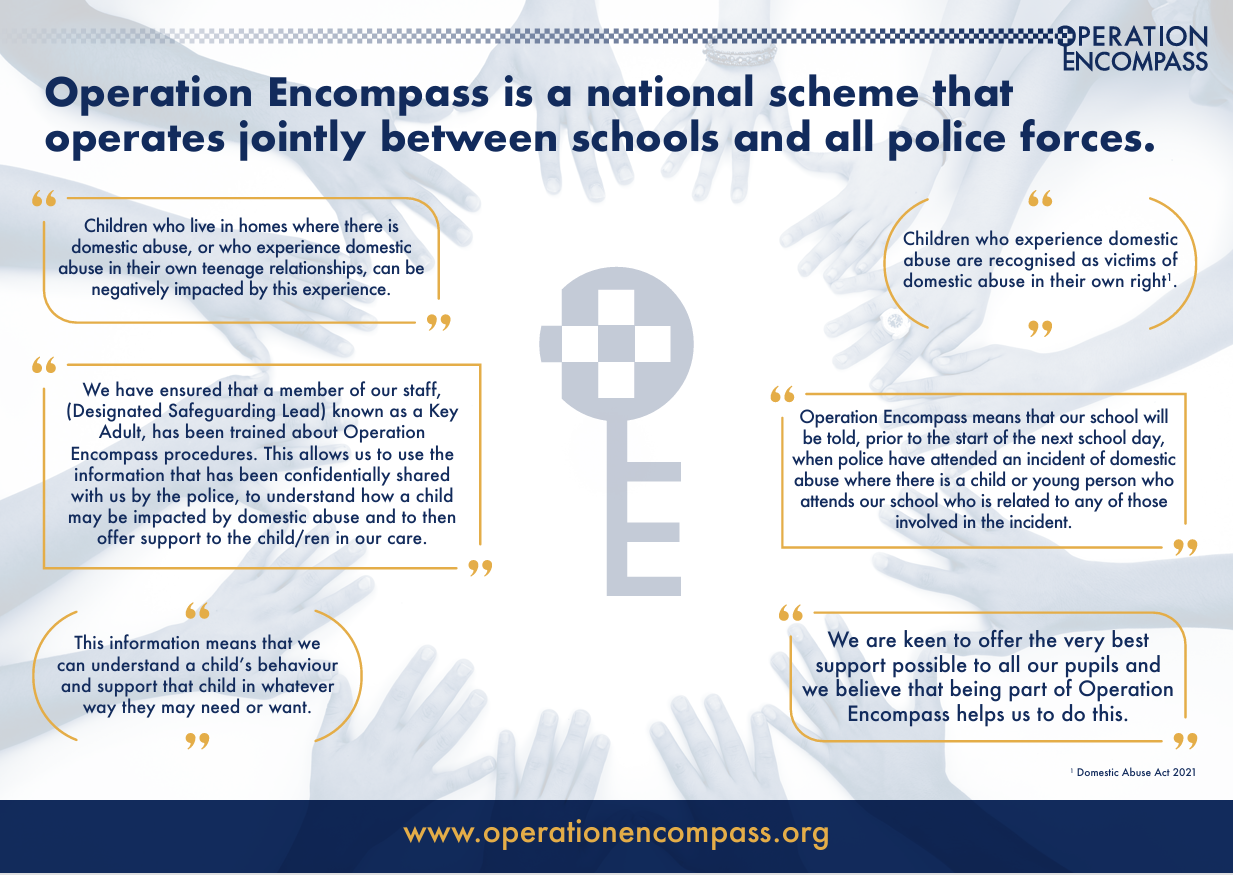
Operation Encompass